วันศุกร์ที่ 9 พฤศจิกายน พ.ศ. 2550

1900 to 1914 (The "Pioneer Era") 2

Langley

On May 6, 1896, Langley's Aerodrome No.5 made the first successful flight of an unpiloted, engine-driven heavier-than-air craft of substantial size. It was launched from a spring-actuated catapult mounted on top of a houseboat on the Potomac River near Quantico, Virginia. Two flights were made that afternoon, one of 1,005 m (3,300 ft) and a second of 700 m (2,300 ft), at a speed of approximately 25 miles per hour. On both occasions, the Aerodrome No.5 landed in the water, as planned, because, in order to save weight, it was not equipped with landing gear.

On November 28, 1896, another successful flight was made with the Aerodrome No.6. This flight was witnessed and photographed by Alexander Graham Bell. It was flown a distance of approximately 1,460 m (4,790 ft). The Aerodrome No.6 was actually Aerodrome No.4 greatly modified. So little remained of the original aircraft that it was given the new designation of Aerodrome No.6.

With the success of the Aerodrome No. 5 and its follow-on No. 6, Langley started looking for funding to build a full-scale man-carrying version of his designs. He succeeded in winning $50,000 in funding from the government, perhaps spurred on by the recent opening of the Spanish-American War. Langley planned on building a scaled-up version known as the Aerodrome A, and started with the smaller Quarter-scale Aerodrome, which flew twice on June 18, 1901, and then again with a newer and more powerful engine in 1903.

With the basic design apparently successfully tested, he then turned to the problem of a suitable engine. He contracted Stephen Balzer to build him one, but was disappointed when it delivered only 8 horsepower (6 kW) instead of 12 hp (9 kW) as he expected. Langley's assistant, Charles M. Manly, then reworked the design into a five-cylinder water-cooled radial that delivered 52 horsepower (39 kW) at 950 rpm, a feat that took years to duplicate. Now with both power and a design, Langley put the two together with great hopes.

To his dismay, the resulting aircraft proved to be too fragile. He had apparently overlooked the effects of minimum gauge, and simply scaling up the original small models resulted in a design that was too heavy to hold itself up. Two launches in late 1903 both ended with the Aerodrome crashing into the water almost immediately after launch.

His attempts to gain further funding failed, and his efforts ended -- only weeks later the Wright brothers successfully flew their aptly-named Flyer.

(Glenn Curtiss made several modifications to the Aerodrome and successfully flew it in 1914 -- the Smithsonian Institution thus continued to boast that Langley's Aerodrome was the first machine "capable of flight".)

1900 to 1914 (The "Pioneer Era") 1

Lighter than air

The first aircraft to make routine controlled flights were non-rigid airships (later called "blimps".) The most successful early pioneer of this type of aircraft was the Brazilian Alberto Santos-Dumont. Santos-Dumont effectively combined a balloon with an internal combustion engine. On October 19, 1901 he became world famous when he flew his airship "Number 6" over Paris from the Parc Saint Cloud around the Eiffel Tower and back in under thirty minutes to win the Deutsch de la Meurthe prize. After this triumph in airships, Santos-Dumont would go on to design and build several aircraft. The subsequent controversy surrounding his and others' competing claims with regard to aircraft would come to overshadow and obscure his unparalleled contributions to the development of airships.

At the same time that non-rigid airships were starting to have some success, rigid airships were also becoming more advanced. Indeed, rigid body dirigibles would be far more capable than fixed wing aircraft in terms of pure cargo carrying capacity for decades. Dirigible design and advancement was brought about by the German count, Ferdinand von Zeppelin.

Construction of the first Zeppelin airship began in 1899 in a floating assembly hall on Lake Constance in the Bay of Manzell, Friedrichshafen. This was intended to ease the starting procedure, as the hall could easily be aligned with the wind. The prototype airship LZ 1 (LZ for "Luftschiff Zeppelin") had a length of 128 m, was driven by two 14.2 ps (10.6 kW) Daimler engines and balanced by moving a weight between its two nacelles.

The first Zeppelin flight occurred on July 2, 1900. It lasted for only 18 minutes, as LZ 1 was forced to land on the lake after the winding mechanism for the balancing weight had broken. Upon repair, the technology proved its potential in subsequent flights, beating the 6 m/s velocity record of French airship La France by 3 m/s, but could not yet convince possible investors. It would be several years before the Count was able to raise enough funds for another try.

Modern Flight 3

Picking up the pace


The 1880s became a period of intense study, characterized by the "gentleman scientists" who represented most research efforts until the 20th century. Starting in the 1880s advancements were made in construction that led to the first truly practical gliders. Three people in particular were active: Otto Lilienthal, Percy Pilcher and Octave Chanute. One of the first truly modern gliders appears to have been built by John J. Montgomery; it flew in a controlled manner outside of San Diego on August 28, 1883. It was not until many years later that his efforts became well known. Another delta hang-glider had been constructed by Wilhelm Kress as early as 1877 near Vienna.

Otto Lilienthal of Germany duplicated Wenham's work and greatly expanded on it in 1874, publishing all of his research in 1889. He also produced a series of ever-better gliders, and in 1891 was able to make flights of 25 meters or more routinely. He rigorously documented his work, including photographs, and for this reason is one of the best known of the early pioneers. He also promoted the idea of "jumping before you fly", suggesting that researchers should start with gliders and work their way up, instead of simply designing a powered machine on paper and hoping it would work. His type of aircraft is now know as a hang glider.

Lilienthal knew that once an engine was attached to the plane it would be nearly impossible to further study the laws of aviation. The finding and describing of many of those laws were his greatest heritage to his successors, as they were able to construct their planes accordingly and thereby save themselves years of trial and error.

By the time of his death in 1896 he had made 2500 flights on a number of designs, when a gust of wind broke the wing of his latest design, causing him to fall from a height of roughly 56 ft (17 m), fracturing his spine. He died the next day, with his last words being "sacrifices must be made". Lilienthal had been working on small engines suitable for powering his designs at the time of his death.

Picking up where Lilienthal left off, Octave Chanute took up aircraft design after an early retirement, and funded the development of several gliders. In the summer of 1896 his troop flew several of their designs many times at Miller Beach, Indiana, eventually deciding that the best was a biplane design that looks surprisingly modern. Like Lilienthal, he heavily documented his work while photographing it, and was busy corresponding with like-minded hobbyists around the world. Chanute was particularly interested in solving the problem of natural stability of the aircraft in flight, one which birds corrected for by instinct, but one that humans would have to do manually. The most disconcerting problem was longitudinal stability, because as the angle of attack of a wing increased, the center of pressure moved forward and made the angle increase more. Without immediate correction, the craft would pitch up and stall.

Throughout this period, a number of attempts were made to produce a true powered aircraft. However the majority of these efforts were doomed to failure, being designed by hobbyists who did not have a full understanding of the problems being discussed by Lilienthal and Chanute.
In
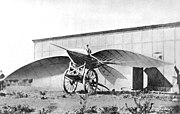
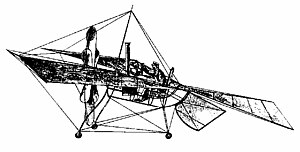
France Clément Ader successfully launched his steam powered Eole for a short 50 meter flight near Paris in 1890, making it the first self-propelled "long distance" flight in history. After this test he immediately turned to a larger design, which took five years to build. However, this design, the Avion III, was too heavy and was barely able to leave the ground. The plane reportedly managed to fly a distance of 300 meters, at a small height.

In 1884, Alexander Mozhaysky's monoplane design made what is now considered to be a power assisted take off or 'hop' of 60-100 feet (20-30 meters) near Krasnoye Selo, Russia.

Sir Hiram Maxim studied a series of designs in England, eventually building a monstrous 7,000 lb (3,175 kg) design with a wingspan of 105 feet (32 m), powered by two advanced low-weight steam engines which delivered 180 hp (134 kW) each. Maxim built it to study the basic problems of construction and power and it remained without controls, and, realizing that it would be unsafe to fly, he instead had a 1,800 foot (550 m) track constructed for test runs. After a number of test runs working out problems, on July 31, 1894 they started a series of runs at increasing power settings. The first two were successful, with the craft "flying" on the rails. In the afternoon the crew of three fired the boilers to full power, and after reaching over 42 mph (68 km/h) about 600 ft (180 m) down the track the machine produced so much lift it pulled itself free of the track and crashed after flying at low altitudes for about 200 feet (60 m). Declining fortunes left him unable to continue his work until the 1900s, when he was able to test a number of smaller designs powered by gasoline.

Another less successful early experimenter was Samuel Pierpont Langley. After a distinguished career in astronomy and a tenure at the Smithsonian Institution, Langley started a serious investigation into aerodynamics at what is today the University of Pittsburgh. In 1891 he published Experiments in Aerodynamics detailing his research, and then turned to building his designs. On May 6, 1896, Langley's Aerodrome No.5 made the first successful flight of an unpiloted, engine-driven heavier-than-air craft of substantial size. It was launched from a spring-actuated catapult mounted on top of a houseboat on the Potomac River near Quantico, Virginia. Two flights were made that afternoon, one of 1,005 m (3,300 ft) and a second of 700 m (2,300 ft), at a speed of approximately 25 miles per hour.

On November 28, 1896, another successful flight was made with the Aerodrome No.6. This flight was witnessed and photographed by Alexander Graham Bell. It was flown a distance of approximately 1,460 m (4,790 ft).

In the United Kingdom an attempt at heavier-than-air flight was made by the aviation pioneer Percy Pilcher. Pilcher had built several working gliders, The Bat, The Beetle, The Gull and The Hawk, which he flew successfully during the mid to late 1890s. In 1899 he constructed a prototype powered aircraft which, recent research has shown, would have been capable of flight. However, he died in a glider accident before he was able to test it, and his plans were forgotten for many years.

Modern Flight 2

Toward better understanding

The first published paper on aviation was
"Sketch of a Machine for Flying in the Air" by Emanuel Swedenborg published in 1716. This flying machine consisted of a light frame covered with strong canvas and provided with two large oars or wings moving on a horizontal axis, arranged so that the upstroke met with no resistance while the downstroke provided lifting power. Swedenborg knew that the machine would not fly, but suggested it as a start and was confident that the problem would be solved. He said, "It seems easier to talk of such a machine than to put it into actuality, for it requires greater force and less weight than exists in a human body. The science of mechanics might perhaps suggest a means, namely, a strong spiral spring. If these advantages and requisites are observed, perhaps in time to come some one might know how better to utilize our sketch and cause some addition to be made so as to accomplish that which we can only suggest. Yet there are sufficient proofs and examples from nature that such flights can take place without danger, although when the first trials are made you may have to pay for the experience, and not mind an arm or leg." Swedenborg would prove prescient in his observation that powering the aircraft through the air was the crux of flying.

During the last years of the 18th century, Sir George Cayley started the first rigorous study of the physics of flight. In 1799 he exhibited a plan for a glider, which except for planform was completely modern in having a separate tail for control and having the pilot suspended below the center of gravity to provide stability, and flew it as a model in 1804. Over the next five decades Cayley worked on and off on the problem, during which he invented most of basic aerodynamics and introduced such terms as lift and drag. He used both internal and external combustion engines, fueled by gunpowder, but it was left to Alphonse Penaud to make powering models simple, with rubber power. Later Cayley turned his research to building a full-scale version of his design, first flying it unmanned in 1849, and in 1853 his coachman made a short flight at Brompton, near Scarborough in Yorkshire.

In 1848, John Stringfellow had a successful test flight of a steam-powered model, in Chard, Somerset, England. This was 'unmanned'.

In
1866 a Polish peasant, sculptor and carpenter by the name of Jan Wnęk built and flew a controllable glider. Wnęk was illiterate and self-taught, and could only count on his knowledge about nature based on observation of birds' flight and on his own builder and carver skills. Jan Wnęk was firmly strapped to his glider by the chest and hips and controlled his glider by twisting the wing's trailing edge via strings attached to stirrups at his feet. Church records indicate that Jan Wnęk launched from a special ramp on top of the Odporyszów church tower; The tower stood 45 m high and was located on top of a 50 m hill, making a 95 m (311 ft) high launch above the valley below. Jan Wnęk made several public flights of substantial distances between 1866 - 1869, especially during religious festivals, carnivals and New Year celebrations. Wnęk left no known written records or drawings, thus having no impact on aviation progress. Recently, Professor Tadeusz Seweryn, director of the Kraków Museum of Ethnography, has unearthed church records with descriptions of Jan Wnęk's activities.

In 1856, Frenchman Jean-Marie Le Bris made the first flight higher than his point of departure, by having his glider "L'Albatros artificiel" pulled by a horse on a beach. He reportedly achieved a height of 100 meters, over a distance of 200 meters.

In 1874, Félix du Temple built the "Monoplane", a large plane made of aluminium in Brest, France, with a wingspan of 13 meters and a weight of only 80 kilograms (without the driver). Several trials were made with the plane, and it is generally recognized that it achieved lift off under its own power after a ski-jump run, glided for a short time and returned safely to the ground, making it the first successful powered flight in history, although the flight was only a short distance and a short time.

Another person who advanced the art of flying was Francis Herbert Wenham, who unsuccessfully attempted to build a series of unmanned gliders. During his work he found that the majority of the lift from a bird-like wing appeared to be generated at the front, and concluded that long, thin wings would be better than the bat-like ones suggested by many, because they would have more leading edge for their weight. Today this measure is known as aspect ratio. He presented a paper on his work to the newly formed Royal Aeronautical Society of Great Britain in 1866, and decided to prove it by building the world's first wind tunnel in 1871. Members of the Society used the tunnel and learned that cambered wings generated considerably more lift than expected by Cayley's Newtonian reasoning, with lift-to-drag ratios of about 5:1 at 15 degrees. This clearly demonstrated the ability to build practical heavier-than-air flying machines; what remained was the problem of powering them, and controlling the flight.

Modern Flight 1

Lighter than air

The 1884 La France, the first fully controllable airship
Although many people think of human flight as beginning with the aircraft in the early 1900s, in fact people had already been flying for some 200 years.


The first generally recognized human flight took place in Paris in 1783. Jean-François Pilâtre de Rozier and François Laurent d'Arlandes went 5 miles (8 km) in a hot air balloon invented by the Montgolfier brothers. The balloon was powered by a wood fire, and was not steerable: that is, it flew wherever the wind took it.

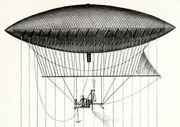
The navigable balloon created by Giffard in 1852
Ballooning became a major "rage" in Europe in the late
18th century, providing the first detailed understanding of the relationship between altitude and the atmosphere.

Work on developing a steerable (or dirigible) balloon (now called an airship) continued sporadically throughout the 1800s. The first powered, controlled, sustained lighter-than-air flight is generally believed to have taken place in 1852 when Henri Giffard flew 15 miles (24 km) in France, with a steam engine driven craft.

Another notable advance was made in 1884, when the first fully controllable free-flight was made in a French Army electric-powered airship, La France, by Charles Renard and Arthur Krebs. The 170 foot long , 66,000 cubic foot airship covered 8 km (5 miles) in 23 minutes with the aid of an 8-1/2 horsepower electric motor.

However, these aircraft were generally short-lived and extremely frail. Routine, controlled flights would not come to pass until the advent of the internal combustion engine (see below.)
Although airships were used in both
World War I and II, and continue on a limited basis to this day, their development has been largely overshadowed by heavier-than-air craft.

Early Flight 3

Renaissance Europe and the Ottoman Empire

Leonardo da Vinci's Ornithopter wings
Some five centuries after Ibn Firnas,
Leonardo da Vinci came up with a hang glider design in which the inner parts of the wings are fixed, and some control surfaces are provided towards the tips (as in the gliding flight in birds). While his drawings exist and are deemed flightworthy in principle, he himself never flew in it. Based on his drawings, and using materials that would have been available to him, a prototype constructed in the late 20th century was shown to fly.
However, his sketchy design was interpreted with modern knowledge of aerodynamic principles, and whether his actual ideas would have flown is not known. A model he built for a test flight in 1496 did not fly, and some other designs, such as the four-person screw-type helicopter have severe flaws.

In the 17th century, the Ottoman traveller Evliya Çelebi reported that in 1630-1632, he saw the Ottoman Turkish polymath Hezarfen Ahmet Celebi using a winged aircraft to fly across the Bosporus. He jumped off the Galata Tower (55m high) in Istanbul, and allegedly flew a distance of about 3km, and landed on the other (Asian) side, uninjured. A glide of 3 km from a launching height of 3km would at best require a modern glider to have considerable skill and practice, though it is known Celebi had practiced considerably prior to his flight.

In 1633, Hezarfen's brother, Lagari Hasan Çelebi, launched himself in the air in a seven-winged rocket, which was composed of a large cage with a conical top filled with gunpowder. This was the first known example of a manned rocket and an artifically-powered aircraft. The flight was accomplished as a part of celebrations performed for the birth of Ottoman Emperor Murad IV's daughter. Evliya reported that Lagari had made a soft landing in the Bosporus by using the wings attached to his body as a parachute after the gunpowder was consumed, foreshadowing the sea-landing methods of astronauts with parachutes after their voyages from outer space.

The flight was estimated to have lasted about twenty seconds and the maximum height reached around 300 metres. Lagari was rewarded by the sultan with a valuable military position in the Ottoman army.

In 1670 Francesco Lana de Terzi published work that suggested lighter than air flight would be possible by having copper foil spheres that contained a vacuum that would be lighter than the displaced air, lift an airship (rather literal from his drawing). While not being completely off the mark, he did fail to realize that the pressure of the surrounding air would smash the spheres.

Early Flight 2

Parachutes and Gliders in Umayyad Spain

Minaret of the Great Mosque at Córdoba. In 852, Ibn Firnas is said to have jumped off the top in a parachute-like apparatus, and survived with minor injuries.


Islamic Spain during the Umayyad renaissance under the Caliphate of Cordoba witnessed several attempts at flight by the Arab polymath and inventor Abbas Ibn Firnas (his name is sometimes Latinized as "Armen Firman", leading to some confusion whether these two are different people), who was supported by the Emir Abd ar-Rahman II. In 852 he made a set of wings with cloth stiffened by wooden struts. With this umbrella-like apparatus, Ibn Firnas jumped off the minaret of the Grand Mosque in Cordoba - while he could not fly, his apparatus slowed his fall, and he escaped with minor injuries. His device is now considered to have been a prototype of the modern parachute.

Twenty-five years later, at the age of 65, Ibn Firnas came up with an improved design, which included the first flight control surfaces. He took this set of wings, considered to be the first hang glider, to a small hill called Jabal al-'arus, and apparently managed to fly for quite some time, by some accounts as long as ten minutes. This was the first attempt at controlled flight, as he was able to alter his altitude and change his direction in order to return to where he flew from. After successfully returning to his starting point, he eventually crashed to the ground, and said later that the landing could have been improved by providing a tail apparatus. His flight was apparently the inspiration for Eilmer of Malmesbury, more than a century later, who would fly for about 200 meters using a similar glider (circa 1010).