วันเสาร์ที่ 10 พฤศจิกายน พ.ศ. 2550

1939 - 1945: World War II

World War II saw a drastic increase in the pace of aircraft development and production. All countries involved in the war stepped up development and production of aircraft and flight based weapon delivery systems, such as the first long range bomber. Fighters were critical to the success of the heavy bombers, allowing much lower losses than would have been the case without fighter protection.

World War II saw a number of technological advances that were remarkable for its day: The first functional jetplane was the Heinkel He 178 (Germany), flown by Erich Warsitz in 1939 (a Coanda-1910 is said to have done a short involuntary flight on 16 December 1910). The first cruise missile (V-1), the first ballistic missile (V-2), and the first manned rocket Bachem Ba 349 were also developed by Germany. However, the small number of Jet fighters did not have significant impact, the V-1 was not very effective as it was slow and vulnerable, and the V-2 could not hit targets precisely enough.

The following table shows how aircraft production in the United States drastically increased over the course of the war.

Type 1940 1941 1942 1943 1944 1945 Total
Very Heavy Bombers 0 0 4 91 1,147 2,657 3,899
Heavy Bombers 19 181 2,241 8,695 3,6812 7,874 42,691
Medium Bombers 24 326 2,429 3,989 3,636 1,432 11,836
Light Bomber 16 373 1,153 2,247 2,276 1,720 7,785
Fighters 187 1,727 5,213 11,766 18,291 10,591 47,775
Reconnaissance 10 165 195 320 241 285 1,216
Transports 5 133 1,264 5,072 6,430 3,043 15,947
Trainers 948 5,585 11,004 11,246 4,861 825 34,469
Communication/ Liaison 0 233 2,945 2,463 1,608 2,020 9,269
Total by Year 1,209 8,723 26,448 45,889 51,547 26,254 160,070

วันศุกร์ที่ 9 พฤศจิกายน พ.ศ. 2550

1918 - 1939 (The "Golden Age")

The years between World War I and World War II saw a large advancement in aircraft technology.

Aircraft evolved from being constructed of mostly wood and canvas to being constructed almost entirely of aluminium. Engine development proceeded apace, with engines moving from in-line water cooled gasoline engines to rotary and radial air cooled engines, with a commensurate increase in propulsive power. Pushing all of this forward were prizes for distance and speed records. For example Charles Lindbergh took the Orteig Prize of $25,000 for his solo non-stop crossing of the Atlantic, the first person to achieve this, although not the first to carry out a non-stop crossing. That was achieved eight years earlier when Captain John Alcock and Lieutenant Arthur Brown co-piloted a Vickers Vimy nonstop from St. John's, Newfoundland to Clifden, Ireland on June 14, 1919, winning the £10,000 ($50,000) Northcliffe prize.

After WWI experienced fighter pilots were eager to show off their new skills. Many American pilots became barnstormers, flying into small towns across the country and showing off their flying abilities, as well as taking paying passengers for rides. Eventually the barnstormers grouped into more organized displays. Air shows sprang up around the country, with air races, acrobatic stunts, and feats of air superiority. The air races drove engine and airframe development - the Schneider Trophy for example led to a series of ever faster and sleeker monoplane designs culminating in the Supermarine S.6B, a direct forerunner of the Spitfire. With pilots competing for cash prizes, there was an incentive to go faster. Amelia Earhart was perhaps the most famous of those on the barnstorming/air show circuit. She was also the first female pilot to achieve records such as crossing of the Atlantic and English channels.
The first lighter-than-air crossings of the Atlantic were made by airship in July 1919 by His Majesty's Airship
R34 and crew when they flew from East Lothian, Scotland to Long Island, New York and then back to Pulham, England. By 1929, airship technology had advanced to the point that the first round-the-world flight was completed by the Graf Zeppelin in September and in October, the same aircraft inaugurated the first commercial transatlantic service. However the age of the dirigible ended in 1937 with the terrible fire aboard the Zeppelin Hindenburg. After the now famous footage of the hydrogen-filled Hindenburg burning and crashing on the Lakehurst, New Jersey, landing field, people stopped using airships, despite the fact that most people on board survived. The Hindenburg, combined with the Winged Foot Express disaster that occurred on 21 July, 1919, in Chicago, Illinois, in which 12 civilians died, started the demise of the airship. Flammable gas dirigibles did not burn and crash often, but when they did crash they caused a disproportionate amount of destruction to the crash zone compared with the aeroplanes of the time. It was more shock value than the number of fatalities that caused the retirement of the world's airships. This may not have been the case had helium been available to the Zeppelin company. The United States, holder of the world's only reserves of helium at the time, was loathe to supply it to the company, which was based in Nazi Germany.
In the 1930s development of the jet engine began in Germany and in England. In England Frank Whittle patented a design for a jet engine in 1930 and began developing an engine towards the end of the decade. In Germany Hans von Ohain patented his version of a jet engine in 1936 and began developing a similar engine. The two men were unaware of each others work, and both Germany and Britain had developed jet aircraft by the end of World War II.

1914 - 1918: World War I

Almost as soon as they were invented, planes were drafted for military service. The first country to use planes for military purposes was Bulgaria, whose planes attacked and reconnoitred the Ottoman positions during the First Balkan War 1912-13. The first war to see major use of planes in offensive, defensive and reconnaissance capabilities was World War I. The Allies and Central Powers both used planes extensively. The most famous plane of the war is the Sopwith Camel; it was credited with more aerial victories than any other Allied plane, but was also notorious for its awkward handling resulting in the death of many pilots.

While the concept of using the aeroplane as a weapon of war was generally laughed at before World War I, the idea of using it for photography was one that was not lost on any of the major forces. All of the major forces in Europe had light aircraft, typically derived from pre-war sporting designs, attached to their reconnaissance departments. While early efforts were hampered by the light loads carried, improved two-seat designs soon appeared that were entirely practical.

It was not long before aircraft were shooting at each other, but the lack of any sort of steady point for the gun was a problem. The French solved this problem when, in late 1914, Roland Garros attached a fixed machine gun to the front of his plane, but it was Adolphe Pegoud who would become known as the first "ace", getting credit for five victories, before also becoming the first ace to die in action.

Aviators were styled as modern day knights, doing individual combat with their enemies. Several pilots became famous for their air to air combats, the most well-known is Manfred von Richthofen, better known as the Red Baron, who shot down 80 planes in air to air combat with several different planes, the most celebrated of which was the Fokker Dr.I. On the allied side, René Paul Fonck is credited with the most victories at 75. For the Americans, the most successful ace was Eddie Rickenbacker with 26 victories.

1900 to 1914 (The "Pioneer Era") 6

Seaplane

The first seaplane was invented in March 1910 by the French engineer Henri Fabre. Its name was Le Canard ('the duck'), and took off from the water and flew 800 meters on its first flight on March 28, 1910. These experiments were closely followed by the aircraft pioneers Gabriel and Charles Voisin, who purchased several of the Fabre floats and fitted them to their Canard Voisin airplane. In October 1910, the Canard Voisin became the first seaplane to fly over the river Seine, and in March 1912, the first seaplane to be used militarily from a seaplane carrier, La Foudre ('the lightning').

1900 to 1914 (The "Pioneer Era") 5

Helicopter

In 1877
Enrico Forlanini developed an early unmanned helicopter powered by a steam engine. It was the first of its type that rose to a height of 13 meters, where it remained for some 20 seconds, after a vertical take-off from a park in Milan.

The first manned helicopter known to have risen off the ground took place in 1907 (Cornu, France) though the first practical helicopter was the Focke FA-61 (Germany, 1936).


1900 to 1914 (The "Pioneer Era") 4

Other early flights

At the time, a number of other inventors had made (or claimed to have made) short flights.
Gustave Whitehead reported that he had flown a powered aircraft on 14 August, 1901. He failed to document the flight, but a later replica of his Number 21 was flown successfully. Lyman Gilmore also claimed to have achieved success on 15 May, 1902. In New Zealand, South Canterbury farmer and inventor Richard Pearse constructed a monoplane aircraft that he reputedly flew on March 31 1903. However, even Pearse himself admitted the flight was uncontrolled and ended in a crash-landing on a hedge without having gained any altitude.


Karl Jatho from Hanover conducted a short motorized flight in August 1903, just a few months after Pearse. Jatho's wing design and airspeed did not allow his control surfaces to act properly to control the aircraft.

Also in the summer of 1903, eyewitnesses claimed to have seen Preston Watson make his initial flights at Errol, near Dundee in the east of Scotland. Once again, however, lack of photographic or documentary evidence makes the claim difficult to verify. Many claims of flight are complicated by the fact that many early flights were done at such low altitude that they did not clear the ground effect, and by the complexities involved in the differences between unpowered and powered aircraft.

The Wright Brothers conducted numerous additional flights (about 150) in 1904 and 1905 from Huffman Prairie in Dayton, Ohio and invited friends and relatives. Newspaper reporters did not pay attention after seeing an unsuccessful flight attempt in May 1904.

Public exhibitions of high altitude flights were made by Daniel Maloney in the John Montgomery tandem-wing glider in March and April of 1905 in the Santa Clara, California area. These flights received national media attention and demonstrated superior control of the design, with launches as high as 4,000 feet and landings made at predetermined locations.

Alberto Santos-Dumont made a public flight in Europe on September 13, 1906 in Paris. He used a canard elevator and pronounced wing dihedral, and covered a distance of 221 m (725 ft). Since the plane did not need headwinds or catapults to take off, this flight is considered by some as the first true powered flight. Also, since the earlier attempts of Pearse, Jatho, Watson, and the Wright brothers received less attention from the popular press than Santos-Dumont's flight, its importance to society, especially in Europe and Brazil, is often considered to be greater despite occurring some years later.

Two English inventors Henry Farman and John William Dunne were also working separately on powered flying machines. In January 1908, Farman won the Grand Prix d'Aviation with a machine which flew for 1 km, though by this time many longer flights had already been done.

For example, the Wright Brothers had made flights over 39 km long by 1905. Dunne's early work was sponsored by the British military, and tested in great secrecy in Glen Tilt in the Scottish Highlands. His best early design, the D4, flew in December 1908 near Blair Atholl in Perthshire. Dunne's main contribution to early aviation was stability, which was a key problem with the planes designed by the Wright brothers and Samuel Cody.

On May 14, 1908 the Wright Brothers made what is accepted to be the first two-person aircraft flight, with Charlie Furnas as a passenger.

On 8 July 1908, Thérèse Peltier became the first woman to fly as a passenger in an airplane when she made a flight of 656 feet with Léon Delagrange in Milan, Italy.

Thomas Selfridge became the first person killed in a powered aircraft on September 17, 1908, when Orville crashed his two-passenger plane during military tests at Fort Myer in Virginia.
In late 1908, Mrs Hart O. Berg became the first American woman to fly as a passenger in an airplane when she flew with Wilbur Wright in
Le Mans, France.

On 25 July 1909 Louis Blériot flew the Blériot XI monoplane across the English Channel winning the Daily Mail aviation prize. His flight from Calais to Dover lasted 37 minutes.

On 22 October 1909 Raymonde de Laroche became the first woman to pilot and solo in a powered heavier than air craft. She was also the first woman in the world to receive a pilot's licence.

Controversy over who gets credit for invention of the aircraft has been fuelled by Pearse's and Jatho's essentially non-existent efforts to inform the popular press, by the Wrights' secrecy while their patent was prepared, by the pride of nations, and by the number of firsts made possible by the basic invention. For example, the Romanian engineer Traian Vuia (1872 - 1950) has also been claimed to have built the first self-propelled, heavier-than-air aircraft able to take off autonomously, without a headwind and entirely driven by its own power. Vuia piloted the aircraft he designed and built on March 18, 1906, at Montesson, near Paris. None of his flights were longer than 100 feet (30 m) in length. In comparison, in October 1905, the Wright brothers had a sustained flight of 39 minutes and 24.5 miles (39 km), circling over Huffman Prairie.

1900 to 1914 (The "Pioneer Era") 3

The Wright Brothers

Following Lilienthal's principles of jumping before flying, the brothers built and tested a series of kite and glider designs from 1900 to 1902 before attempting to build a powered design. The gliders worked, but not as well as the Wrights had expected based on the experiments and writings of their 19th century predecessors. Their first glider, launched in 1900, had only about half the lift they anticipated. Their second glider, built the following year, performed even more poorly. Rather than giving up, the Wrights constructed their own wind tunnel and created a number of sophisticated devices to measure lift and drag on the 200 wing designs they tested. As a result, the Wrights corrected earlier mistakes in calculations regarding drag and lift, though they missed the effect of Reynolds number (known since 1883), which would have given them an even bigger advantage. Their testing and calculating produced a third glider design, which they flew in 1902. It performed far better than the previous models. In the end, by establishing their rigorous system of designing, wind-tunnel testing of models and flight testing of full-size prototypes, the Wrights not only built a working aircraft but also helped advance the modern science of aeronautical engineering.

The Wrights appear to be the first design team to make serious studied attempts to simultaneously solve the power and control problems. Both problems proved difficult, but they never lost interest. Eventually, they designed and built an engine that could provide the needed power, and solved the control problem through a system known as "wing warping". Although this method was used only briefly during the history of aviation, it worked at the low airspeeds their designs would fly at, and proved to be a key advance, leading directly to modern ailerons. While many aviation pioneers appeared to leave safety largely to chance, the Wrights' design was greatly influenced by the need to teach themselves to fly without unreasonable risk to life and limb, by surviving crashes. This, not lack of power, was the reason for the low speed and for taking off in a head wind. It was also the reason for the rear-heavy design, for the canard, and for the anhedral wings.

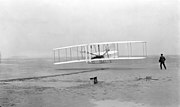
The Wrights made the first sustained, controlled and powered heavier-than-air flight at Kill Devil Hills, North Carolina, a town five miles down the road from Kitty Hawk, North Carolina on December 17, 1903

The first flight by Orville Wright, of 121 feet (37 m) in 12 seconds, was recorded in a famous photograph. In the fourth flight of the same day, Wilbur Wright flew 852 feet (260 m) in 59 seconds. The flights were witnessed by 4 lifesavers and a boy from the village, making them the first public flights and certainly the first well-documented ones.

The telegram station the Wright Brothers used to send their message of successful, sustained, powered flight is now a restaurant named "The Black Pelican."